

We must save Armenia
Azerbaijan wants to erase Armenia. Pashinyan signs agreements that give away the country's very soul, while Russia and the United States see it merely as a pawn in the great game of global power politics. A report from a country that aspires to nothing more than living in peace
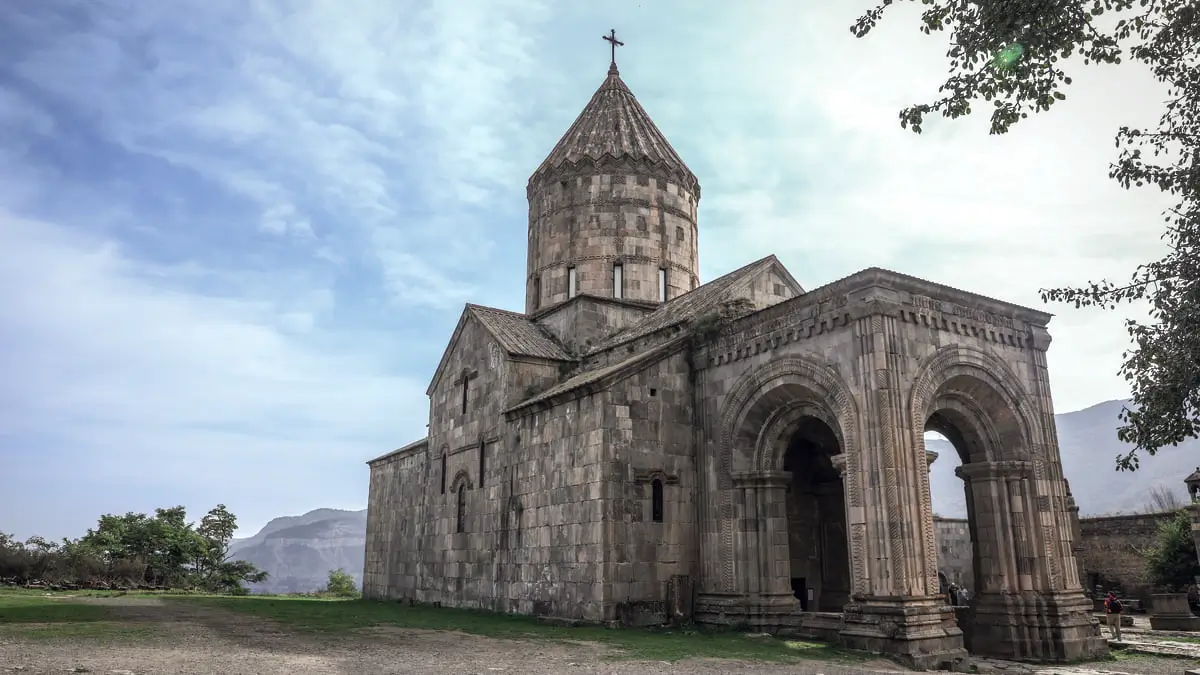
There’s no need to pick up little Narek: just guide the gesture of his arm as he reaches the thin yellow candle toward those already lit, immersed in the sludge of sand and water in the large metal box placed on one side of the ancient church that the Armenians pompously call the Cathedral of the Holy Mother of God. In 1936, the Soviets demolished the 17th-century Great Basilica of the Mother of God here in Yerevan, and during the work, the original core dating back to the 13th century was uncovered. Urgent appeals from archaeologists ensured that the building was spared, and today citizens line up to enter through the narrow entrance, mark themselves in front of an image of the Virgin with the Child, and light a votive candle. Grandmother Gayane trembles as the wick catches fire, the candle lights up, and is plunged among the others. One of these tilts, falls, and sizzles in the thick water. The grandmother’s eyes mist over, and Narek also jolts: their thoughts are crossed by the memory of Uncle Antranig, cut down in his twenties on the battlefield: one of the 4,000 Armenians killed or missing in the 2020/23 war.
The Cathedral of the Holy Mother of God, a small gem of pink and orange tuff surrounded by large buildings just steps away from Republic Square, is a metaphor for Armenia: once a vast kingdom stretching from the Black Sea to the Mediterranean, today a modest territory ten times smaller, reborn to independence after centuries of subordination to regional powers. The last piece of lost Armenian identity is Artsakh/Nagorno-Karabakh, a self-proclaimed autonomous republic contested by Azerbaijan, which claimed it through two bloody offensives in September 2020 and September 2023, interspersed with border clashes and a blockade of supplies that starved the 120,000 Armenian residents of the enclave. Today, all are refugees in the metropolitan territory of Armenia or abroad.
“Western Azerbaijan”
“Our society is tired, placing all its hopes in the peace process. This is the message we want to convey to Azerbaijani society.” Alen Simonyan is the Secretary of the Security Council of Armenia, one of the bodies that, on the Armenian side, deals with the implementation of the joint peace declaration signed in Washington in August 2025 with its Azerbaijani counterpart. He is a prominent member of the Civil Contract party, the ruling party, and has served as the President of the Parliament. An enthusiastic supporter of the peace process based on Armenia’s renunciation of any aspirations related to Nagorno-Karabakh, he still has his doubts: “When we have a meeting with the Azerbaijanis, we leave having established some points; then shortly after, they make statements like referring to Armenia as ‘Western Azerbaijan,’ or calling our Lake Sevan by an Azerbaijani name. But at least in the last year and a half, there have been no more border incidents or casualties.”
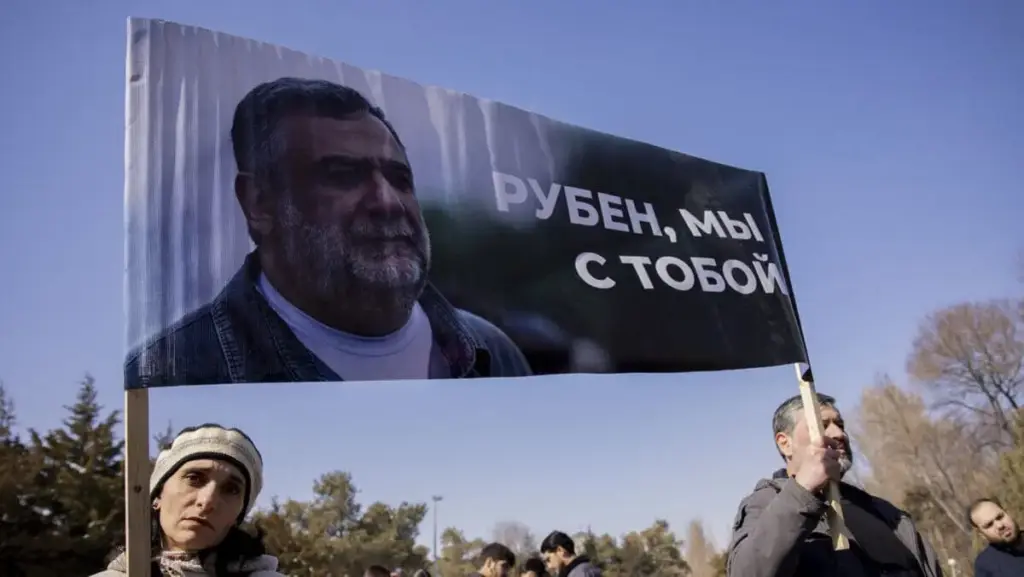
“But what peace process? The truth is that our government is too yielding and extremely incompetent!” Vahan Zanoyan is a harsh critic of Prime Minister Pashinyan’s policy, the man who signed the Washington declaration with Donald Trump and Ilham Aliyev. “It makes unnecessary concessions in exchange for nothing, such as declaring that international recognition of the Armenian genocide is no longer a priority, minimizing Mount Ararat as a national symbol, removing the word “Artsakh” from every public discourse, not insisting on the release of the 19 Armenian prisoners of war incarcerated in Baku while all the Azerbaijani ones have been released, and giving up the defense of the rights of Karabakh refugees who have been stripped of everything they had. You cannot extinguish the Armenian spirit by waving the specter of a new war. I’m not saying we should take up arms; I’m saying we must maintain our dignity. A people deprived of its soul is ready to be colonized, even if formally its state appears independent.” Zanoyan is an Armenian who returned from the diaspora in the U.S., where he served as the CEO of an oil company and a global strategic consultant in the energy sector; today, he is a writer and poet, but also a political commentator. His critiques reflect at least half of the Armenian society: the portion that did not vote for the outgoing government in the last elections, when it was confirmed (last June) with 49.8 percent of the votes (in the previous elections of 2021, it had obtained 53.9).
The current scenario is paradoxical. In the name of the peace process, the Armenian government has prohibited the use of the word “Artsakh” in public discourse (the director of the genocide museum who gifted U.S. Vice President J.D. Vance a book that included the word in the title has been removed from her position), does not support the 600 lawsuits that a thousand refugees from Artsakh/Nagorno-Karabakh have filed with the European Court of Human Rights (ECHR) against the Azerbaijani state to seek the return of, or at least compensation for their confiscated homes and properties, and never officially reacts to the repeated hostile statements from the Azerbaijani side.

The TRIPP project
On the other hand, President Aliyev and his officials do not let a week go by without showering Armenians with epithets such as “dogs,” “fascists,” “rats,” “cancer of humanity,” and “fanatics.” This is compounded by acts and words that deny the very identity of Armenia, such as the presidential statement that “Armenians are a recent presence in this region” (they have been present in Nagorno-Karabakh for two millennia), the attribution of many Armenian-origin churches, now located in Azerbaijani territory, to the ancient, no longer existing Caucasian Albanians, the destruction or erasure of Armenian inscriptions from churches in Shushi, Martuni, and Stepanakert, and from eight cemeteries, the rewriting of history and art history books from which the designation “Armenian” is removed from buildings and monuments and replaced with terms like “Albanian,” “Turkish temple,” or “Turkish Christian temple,” and the obsessive use of the expression “Western Azerbaijan” to refer to the eastern territories of internationally recognized Armenia.
In the face of all this, the Armenian government never reacts and continues to act as if nothing is wrong. Yet, in the eyes of the Azerbaijani power, it is tainted by a guilt that justifies every hostile statement and every obstruction, such as the extreme slowness of the work of the commission for demarcating the final borders between the two states and the failure of the Azerbaijani side to ratify the TRIPP project, an acronym for Trump Route for International Peace and Prosperity, the infrastructure plan conceived by the U.S. president to create a multimodal corridor that would connect Azerbaijan to its exclave of Nakhchivan by crossing the sovereign territory of southern Armenia, effectively linking Central Asia to the Caucasus (and thus to Turkey and Russia). This guilt stems from the failure to repeal the passage contained in the preamble of the Armenian constitution that refers to the “Reunification of the Armenian SSR and the Nagorno-Karabakh Region.” On September 26, 2024, the Constitutional Court of Armenia issued a ruling stating that the reference in the preamble has purely historical-symbolic value and does not represent a territorial claim. However, in Baku, this is not understood, and they demand constitutional reform as a condition for normalizing relations. The problem is that Pashinyan does not have the two-thirds majority in parliament needed for a reform that would not then have to be confirmed by a popular vote; and it is certain that in a constitutional referendum, Armenians would not agree to amend their constitution (specifically, the preamble) under the pressure of another state.

A troubled peace
The reasons behind Azerbaijan’s behavior are well explained by Eric Hacopian, another Armenian from the diaspora who returned back home. While in the U.S., he was a political consultant for the Democratic Party for thirty years, and for the past nine years, a journalist in Armenia and host of the television program Insights with Eric Hacopian. “The issue of the preamble of the constitution is a pretext for not signing the peace agreement. Azerbaijan under Aliyev cannot live without an enemy. The country has no economic future because sooner or later its gas reserves will run out, and despite its current wealth, the average Azerbaijani is poorer than the average Armenian. Aliyev will never sign a definitive peace and will always keep alive the image of Armenians as a threat in the eyes of his public, because with a signed peace, his external problems would become internal. Let’s prepare for an ‘unhappy peace’, meaning a ceasefire under the constant threat of resuming hostilities.”
The threat of Azerbaijani military action to take the south of the country is no longer a current issue, after the United States threatened dire consequences in terms of international isolation and Iran would likely evoke war against Baku if that were to happen. But the memory of the military debacle does not leave the Armenians. “They had drones, Turkish and Israeli; we did not. When you heard them buzzing, you had seven seconds to find shelter, otherwise, you were dead,” recalls a veteran who wishes to remain unidentified. “The reconnaissance unit provided coordinates to the artillery to hit our tanks. Our soldiers used cell phones to communicate, often lacking other systems: the drone would spot them, transmit the coordinates, and they were dead. When the losses became severe, our superiors summoned personnel from the offices and other services: ‘Form groups of 15 people and choose a leader,’ they said. No one knew what they were supposed to do as a leader. They gave 12 helmets to the group of 15 people and said: ‘Those without protection will take the helmets of the fallen.’” Diplomatic sources based in Yerevan agree in their analysis that in the war for Artsakh/Nagorno-Karabakh, an army equipped with Western military technology and NATO standards clashed with an army relying on military technology and strategic doctrine both inherited from the Soviet era.

Russia, China, Iran
Now Armenia is reorganizing its defenses (purchasing arms mainly from France and India), but its security depends primarily on contextual elements such as the implementation of TRIPP. “If the interconnection of the region is realized, it becomes more difficult to imagine that one country would attack another partner in the project, as it would jeopardize the system for all the states benefiting from it,” comments Antranig Kasbarian, former director of Weekly Armenian and an executive of the Tufenkian Foundation, which also assists refugees from Nagorno-Karabakh and had many development programs there before the war disrupted everything. “The project is strongly desired by the United States because it has not only economic value: from the Zangezur corridor (the 43 kilometers of Armenian land that separate the two Azerbaijani territories – Ed.) Americans can keep an eye on Iran and penetrate an area traditionally under Russian influence.” Hacopian agrees with him: “TRIPP is a highly political project that would allow Americans to penetrate Central Asian countries and distance them from the influence of Russia and China. For this reason, it also has the capacity to prevent aggression against Armenia, a central piece of the operation.”
Russia is evidently one of the topics at the heart of Armenia’s discontent. “This is the worst period in history for our relations with Russia,” Simonyan smiles almost amused. The borders that have been blocked for years with Turkey and Azerbaijan have recently been joined by problems with Moscow, which has closed its market to Armenia’s agri-food exports in retaliation for its rapprochement with the United States and the European Union. Armenia was the most pro-Russian country among the post-Soviet states in the Caucasus, but everything changed with the war of 2020-23. “Russian peacekeeping troops did not prevent the Azerbaijanis from blocking access routes to Nagorno-Karabakh, leading to its strangulation to the point of famine, nor did the Russian armed forces intervene, despite the existence of a mutual defense treaty between Russia and Armenia, when Azerbaijan occupied not only the disputed territories but also internationally recognized Armenian areas covering 240 square kilometers,” explains Kasbarian. “Since then, Armenia has initiated a policy that is not anti-Russian but aims at diversifying alliances. Even though the government has no intention of joining NATO, Moscow is furious because Armenians have become completely autonomous in their internal and international decisions. Previously, even the appointments of commanders of the Armenian armed forces were agreed upon by the Kremlin and Yerevan.”
Karekin II on trial
The problems of Armenia, which lights candles in front of the Mother of God because people can achieve nothing on their own, do not end here. More than international threats, the danger of what Zanoyan describes as the death of the Armenian soul weighs heavily: the break in relations between the Armenian Apostolic Church, the guardian of the faith, culture, and history of Armenia, and the government led by Nikol Pashinyan, which has initiated a genuine persecution of the official Church. Religious education in schools has been abolished, military chaplains have been put on leave, the name of one of the main streets in Yerevan has been changed to honor King Pap, the sovereign who historically confiscated the most ecclesiastical property, and in his party’s electoral program, Pashinyan has included the resignation or deposition of Catholicos Karekin II, the “pope” of the Armenian Apostolic Church.
All of this is due to the fact that during the days of military defeat, the spiritual leader of the Armenians had invited the prime minister to resign, and that in light of the recent elections, a political pressure group opposing the government had formed, led by a sitting bishop, Bagrat Galstanyan, who was later arrested on charges of conspiracy against the state. Subsequently, Karekin himself was brought to trial for failing to comply with a civil court order: to restore the ecclesiastical prerogatives to a bishop whom the Catholicos had reduced to lay status, and who had appealed to a state court against this canonical measure…
“The Church is open to dialogue with the State in the interest of the well-being of Armenia and for the resolution of outstanding issues. This has always been the path we have followed over the centuries,” stated Karekin II while receiving a delegation from the American organization “Save Armenia.” “The only interest of the Church is that the government operates successfully. Our historical mission has been and remains the preservation of national identity. For centuries, the Church has preserved the culture and spiritual values of our people, and through its activities, it has contributed to the Armenian people regaining an independent state. We are in favor of peace, keeping in mind that without justice, peace cannot have solid roots.”

The Armenian people humiliated
This tug-of-war does not please Armenians, who, even though they are not very religious anymore, have a positive opinion of the Church. According to recent polls, the Armenian Apostolic Church is the second most esteemed institution among them, with 77 percent of positive or somewhat positive opinions, right after the armed forces, which top the ranking with 81.8 percent. “Undoubtedly, the Church needs to be reformed; there are phenomena of corruption that did not exist under communism, but this cannot be done by the State,” comments Hacopian. “The relationships between Russian circles and our clergy harm the Armenian cause, but the answer cannot be that the State takes charge of the reform of the Church. The government’s anti-clerical attitudes border on the ridiculous and certainly do not please Armenians. Seeing bishops under house arrest, church properties searched by the police, and the Catholicos called to answer for his actions in court is something that wounds the soul of any Armenian. Democracy and peace cannot coincide with the humiliation of the deepest identity of the Armenian people. This is the reproach that many direct at the government.”
The original version of this article appeared in Italian in the November 2026 issue of Tempi monthly magazine

0 commenti
Non ci sono ancora commenti.
I commenti sono aperti solo per gli utenti registrati. Abbonati subito per commentare!